
My Meat Shop Blog
Grocery & Tradition
Why We Use Halal Fish Gelatine: A Safer Route for Desserts, Mousses & Patisserie
A practical My Meat Shop guide explaining why we use YHG-certified halal fish gelatine powder for clearer halal dessert setting, instead of relying on uncertain bovine or mixed industrial gelatine sources.

In our earlier guide, Is Beef Gelatine Halal?, we explained the main issue clearly: beef gelatine can be halal when it comes from cattle slaughtered according to halal requirements and processed under trusted halal controls. Porcine gelatine is not halal. The difficulty begins when the label only says “gelatine”, or when the bovine source and processing route are not clear enough for halal-conscious customers.
Since then, we have taken a stronger practical position for My Meat Shop. Where we need gelatine functionality for our own dessert, patisserie or sweet preparation route, we have chosen to use Halal Fish Gelatine Powder as our preferred and exclusive gelatine route for clarity, safety and customer confidence.
This decision is not because halal beef gelatine is impossible. It is because gelatine supply chains can be difficult to verify unless the source, slaughter route, processing, certification and handling are all controlled properly. At the moment, we are not equipped to produce our own gelatine under our own direct process, so we prefer a clearer, YHG-certified fish gelatine route rather than relying on uncertain industrial bovine gelatine streams.
Quick links for this guide
Why Gelatine Needs Extra Halal Care
Gelatine is a setting ingredient extracted from collagen. In food manufacturing, it can come from different sources, including bovine, porcine, fish and other animal-derived materials depending on the supply chain. For halal customers, the question is not only “is this beef or pork?” It is also “how was the animal sourced, how was it processed, and was the ingredient protected from non-halal handling?”
This is why gelatine can be confusing on ordinary labels. Sometimes the product says “beef gelatine” or “fish gelatine”. Sometimes it only says “gelatine” or “E441”. Sometimes there is no halal mark. Sometimes the source may be declared, but the slaughter and processing route is still not clear enough for a halal-conscious customer.
For a household, this creates uncertainty. For a food business, it creates a bigger responsibility. A dessert, mousse, glaze or marshmallow-style product may look simple, but the gelatine inside it can determine whether the product is suitable for the Muslim customer or not.
Our practical position: when the source, slaughter route, process controls or shared-handling details are not clear enough, we do not want to rely on assumption. For My Meat Shop, fish gelatine gives us a clearer and safer route for gelatine-based dessert work.
Why We Do Not Rely on Unclear Beef Gelatine
Beef gelatine is not automatically haram. If it comes from halal-slaughtered cattle and is processed under trusted halal controls, it can be halal. The problem is that many industrial supply chains are complex. A label may not always tell the customer the full story behind the source, slaughter, factory handling, shared equipment, processing aids or certification route.
Some customers and scholars also discuss the issue of transformation during gelatine processing. This is a serious subject, and it is not always easy for a shopper to apply while reading an ingredient label. That is why many Muslim customers prefer a cautious route: certified halal bovine gelatine, plant-based alternatives, or fish gelatine when the product is properly controlled.
At My Meat Shop, we are not currently equipped to produce our own gelatine from our own fully controlled source. We hope that one day, in shā’ Allāh, we may have the capability to develop or secure a fully controlled halal gelatine route with complete confidence. Until then, we prefer not to place our trust in unclear bovine gelatine supply chains.
This is not about attacking the wider industry. It is about recognising that industrial ingredient handling can involve mixed sources, shared factories and documentation gaps that do not always meet the level of clarity we want for our customers.
Why Fish Gelatine Gives a Clearer Route
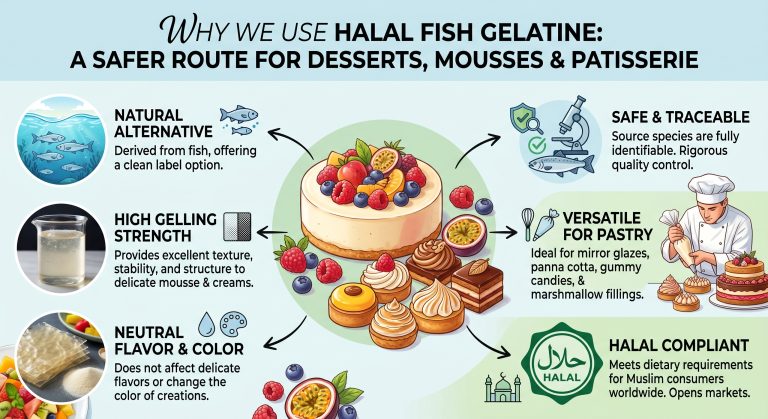
Fish gelatine gives us a simpler and clearer route when we need gelatine functionality. It avoids the common pork concern, avoids the uncertainty around non-halal bovine slaughter, and gives us a practical ingredient for desserts, mousses, jellies, marshmallows, glazes and confectionery-style preparation.
The product we have selected is sold as Halal Fish Gelatine Powder 100g. It is positioned as a halal setting ingredient and is listed with YHG halal certification on the product page. That gives customers a clearer route than guessing whether a hidden or unclear gelatine source is suitable.
For My Meat Shop, the choice is about confidence. If we use gelatine in our own recipes or product development, we want customers to understand the route clearly. Fish gelatine gives us that practical direction today.
Why we prefer halal fish gelatine:
- It avoids pork-derived gelatine entirely.
- It avoids unclear bovine slaughter and processing concerns.
- It gives a more transparent route for halal dessert preparation.
- It is practical for mousses, jellies, glazes and confectionery-style recipes.
- It supports a clearer halal assurance message for customers.
Where Halal Fish Gelatine Works Best
Halal fish gelatine powder is useful when a recipe needs setting power, structure or a soft gelled texture. It is especially useful in dessert, patisserie and sweet preparation, where ordinary gelatine is commonly used.
At home, it can support mousse-style desserts, jelly-style recipes, panna cotta-style desserts, cheesecake-style fillings, marshmallow-style sweets, dessert glazes and shiny sweet finishes. In a small food business or home kitchen, it can become part of a halal dessert pantry because it gives a clearer setting ingredient to keep on hand.
It is important to remember that different gelling agents behave differently. Fish gelatine may not always behave exactly like bovine gelatine or plant-based gelling agents. Recipes, hydration, dissolving method, setting time and temperature all matter. Always follow the recipe and adjust carefully where needed.
Best Used For
Dessert setting, mousses, jelly-style recipes, sweet glazes, marshmallow-style preparation, panna cotta-style desserts and patisserie finishing.
How to Check Gelatine as a Halal Customer
Whether you are shopping for sweets, desserts, supplements or baking ingredients, gelatine should be checked carefully. It is not enough to see the word “gelatine” and assume it is suitable.
Simple gelatine check:
- Check the source: fish, bovine, porcine or unclear.
- Avoid porcine gelatine: pork-derived gelatine is not halal.
- Check certification: look for reliable halal certification where possible.
- Check processing: bovine gelatine needs halal slaughter and halal-controlled handling.
- Check shared handling: factories and suppliers should prevent cross-contamination.
- When unsure: choose a certified product, a fish gelatine route, or a suitable plant-based setting alternative.
This is why My Meat Shop prefers a direct and simple answer for its own use: where gelatine is required, we choose halal fish gelatine powder rather than relying on unclear beef gelatine sources.
Fish Gelatine, Beef Gelatine and Plant-Based Alternatives
There are several ways to set a dessert. Beef gelatine can be suitable when the cattle source and processing are halal-controlled. Fish gelatine gives a clearer route for many halal-conscious users when it is properly certified and handled. Plant-based alternatives such as agar, pectin and carrageenan can also be useful, but they do not behave exactly like gelatine.
For example, agar often sets firmer and can give a different texture. Pectin is useful in jams and fruit-based preparations. Carrageenan is used in some dairy-style and dessert applications. Fish gelatine is useful when a recipe specifically needs gelatine-like behaviour but the customer wants to avoid uncertain bovine or porcine sources.
This does not mean one ingredient solves every recipe. It means the choice should match the recipe, the texture, the halal requirement and the level of assurance required.
Why This Matters for My Meat Shop Customers
My Meat Shop customers do not only want ingredients that work technically. They want ingredients that make sense for a halal household. That means the product must be practical in the kitchen, but also clear in its halal route.
For families, this means desserts and sweets can be prepared with more confidence. For customers who bake regularly, it gives a halal setting ingredient to keep in the cupboard. For home bakers and small food businesses, it reduces the need to keep asking whether an ordinary gelatine source is suitable.
For our own direction as a business, the decision is also about responsibility. If we are not fully equipped to produce gelatine ourselves, we prefer to choose a clearer halal fish gelatine route rather than rely on unclear animal-derived gelatine sources that may not meet the level of assurance our customers expect.
How to Use Halal Fish Gelatine Powder Safely
Use halal fish gelatine powder according to the recipe you are following. Measure carefully, dissolve properly and give the dessert enough time to set. Do not guess the quantity if the recipe depends on a precise texture.
Store the powder sealed in a cool, dry place. Once the product is opened, follow the label or spec sheet for best storage practice. If a prepared dessert contains dairy, cream, fruit or other chilled ingredients, store the final dessert according to the most sensitive ingredient in the recipe.
Practical kitchen tips:
- Measure accurately rather than adding by eye.
- Follow the recipe instructions for blooming, dissolving or mixing.
- Allow enough chilling and setting time.
- Test small batches before scaling up for events or commercial use.
- Keep the powder sealed and protected from moisture.
Frequently Asked Questions
Why does My Meat Shop use fish gelatine?
We use halal fish gelatine because it gives us a clearer route for dessert setting and patisserie-style work, avoiding uncertainty around pork-derived gelatine, unclear bovine sources and mixed industrial handling.
Is beef gelatine always haram?
No. Beef gelatine can be halal when it comes from halal-slaughtered cattle and is processed under proper halal controls. The problem is when the source, slaughter route, processing or certification is unclear.
Is pork gelatine halal?
No. Porcine or pork-derived gelatine is not halal and should be avoided by halal-conscious customers.
What can halal fish gelatine be used for?
It can be used for desserts, mousses, jellies, marshmallows, glazes, panna cotta-style recipes, cheesecake-style fillings and confectionery-style sweet preparation where gelatine functionality is needed.
Does fish gelatine behave exactly like beef gelatine?
Not always. Different gelatine and gelling ingredients can set differently. Follow the recipe, measure carefully and test the texture when using it in a new preparation.
Will My Meat Shop produce its own gelatine in the future?
We are not currently equipped to produce our own gelatine under our own direct process. We hope that in the future, in shā’ Allāh, a fully controlled halal gelatine route may become possible. Until then, halal fish gelatine is our clearer safety-first choice.
Choose a Clearer Halal Gelatine Route
Use YHG-certified Halal Fish Gelatine Powder for desserts, mousses, jellies, marshmallows, glazes and patisserie-style preparation when you want a clearer halal setting ingredient.
Butcher’s Picks
Halal Beef Short Ribs (Argentinian Style) — Pack of 5
Halal Beef Smash Burger
Halal Lamb Carcass (Pre-Order)
Halal Beef Burger Patty



 Halal Milk-Fed Veal Prime Steaks
 Halal Charcuterie Slices
 French & European Cuisine
 Deli & Sandwich Cuisine
 Street Food Cuisine
 North African Cuisine
 West African Cuisine
 World Cuisine
 Rotisserie & Grill Cuisine
 Middle Eastern Catering Cuisine
 Kro&Kat Pet Food